Between an $80 trench and a $900 one, the silhouette barely moves; the fabric and the build are the entire difference. The honest tier for most wardrobes is the middle — roughly $250 to $400 at last check (February 2026) — where real cotton gabardine and proper finishing appear. This edit compares all three tiers, names the details that matter, and argues where $900 is and is not justified. Prices are market examples verified against typical listings; if you buy through links in our shopping guides, Zebule may earn a commission at no cost to you.
What fabric should a trench actually be?
Cotton gabardine — the tightly woven twill the trench was built on — or a close cotton twill. Gabardine is the fabric argument: dense enough to shed a drizzle, breathable enough for a 15-degree day, and it breaks in like denim rather than rustling like a raincoat. The low tier substitutes polyester twill, which is water-resistant but swelters, holds a permanent squeak of a crease, and dates faster because the drape never softens. A coated cotton at $150 splits the difference honestly.
The $80 trench: what you get and what you do not
You get the picture: double-breasted front, belt, gun flap, storm shield — all the vocabulary present. What you do not get is finishing. Check the inside first at this tier: the lining is usually thin polyester, seams are serged rather than finished with binding, the belt loops are single-stitched, and the buckles are lightweight coated metal that chips within a season. For one transitional season of light wear, it is a fair rental. For a coat you plan to keep, it is a false start — the trench's whole case is longevity.
Comparing the three tiers
| Detail | ~$80 | ~$300 | ~$900 |
|---|---|---|---|
| Fabric | Poly twill or coated cotton | Cotton gabardine | Woven-in-England gabardine |
| Water handling | Surface resistance only | Sheds drizzle, breathes | Same, denser weave |
| Finishing | Serged seams, light buckles | Bound seams, solid hardware | Hand-finished details, horn buckles |
| Storm details | Decorative flaps | Functional gun flap and shield | Functional, reinforced |
| Best for | One season, light wear | The ten-year coat | Lifelong piece, heritage buyer |
Which trench details genuinely matter?
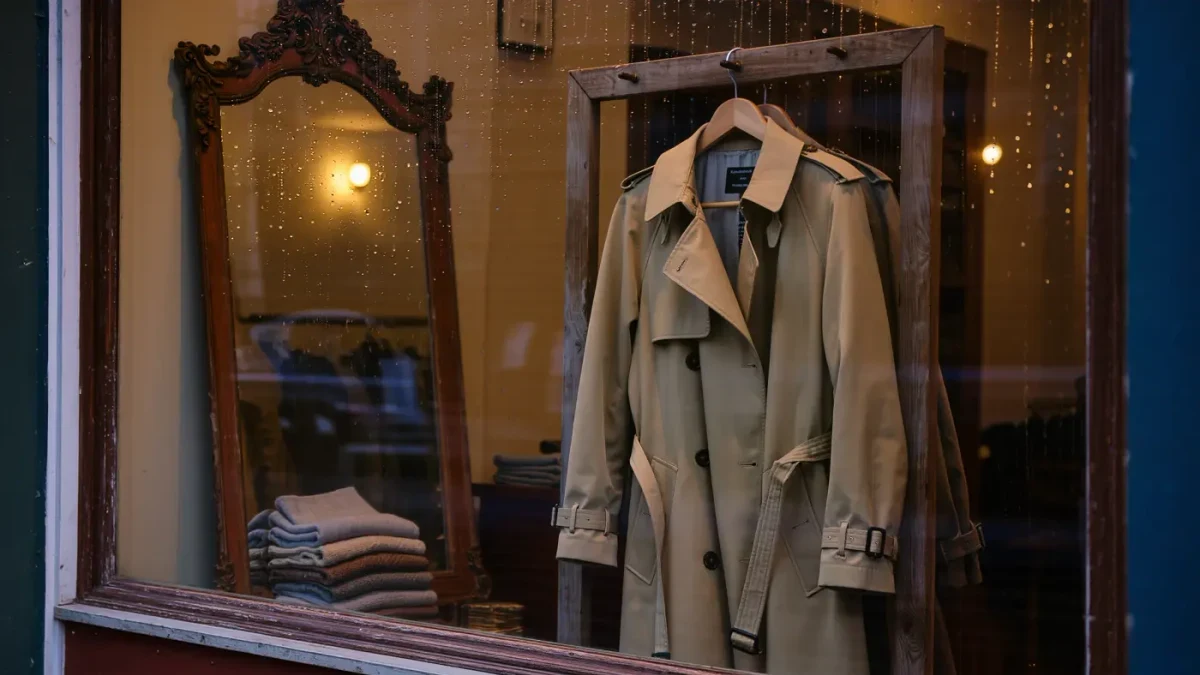
- The storm flap and shield. The back storm shield and the right-breast gun flap are functional weather architecture; at the middle tier and above they are lined and set to channel water. Flat, unlined versions are costume.
- The belt and D-rings. The belt should be the same fabric as the coat, generous enough to knot properly, with metal D-rings that hold a knot. A belt that will not hold a knot ruins the coat's best styling move.
- The collar and throat latch. A good collar stands when turned up and the throat latch closes without a fight — that is rain gear, not decoration.
- Vent and length. A center-back vent to the knee, and a hem at or just past the knee: shorter reads trendy and dates; the classic length is the point of the garment.
Is the $900 trench ever the answer?
For a specific buyer, yes: if you want one coat for life, cut to be re-tailored, with gabardine woven by a mill that has supplied the style since before living memory, the top tier delivers a garment that outlives fashion and can be inherited. On cost-per-wear over twenty years it is defensible arithmetic. For everyone else, the middle tier contains every functional detail; the top tier adds provenance, which is a luxury, not a feature.
How should a trench fit?
Room for one blazer underneath at the shoulder, no more — a trench cut too large swings like a sack. The belt defines the waist but the coat must stand on its own with the belt tied back. Sleeves end at the wrist bone with a centimeter of shirt cuff showing; the classic lets the cuff show and it is half the charm. And buy for the shoulder: a trench's raglan or set-in shoulder cannot be taken in convincingly.
How do you style a trench without dating it?
The trench is one of the few garments that arrives with styling rules baked in, and most attempts to modernize it are what date it — not the coat. The argued defaults: wear it open in mild weather with the belt tied back in a single knot, so the drape does the talking; belt it properly at the waist only with tailoring underneath, where the defined waist reads as intention rather than costume. Turn the collar up in rain and nowhere else; a permanently upturned collar is a movie reference, not a styling choice. Trouser pairings beat jeans slightly — the coat's military-straight line agrees with a fuller trouser — but a raw straight jean under a mid-tier gabardine is the version of this coat that works hardest in real weeks. Keep footwear leather; the trench's formality leaks downward. And resist the cropped trench: proportion is the one place trend crept into the silhouette, and the knee-length hem is both the weather architecture and the reason the coat has outlived every decade since its service origins. Style the middle-tier coat with restraint and it reads like the $900 one; style the $900 one with novelty and it reads like a costume.
The thesis: the trench is the one coat where fabric is the product — pay the middle tier for real gabardine and functional storm details, and let $900 remain what it is, a heritage purchase.
Sources for this piece include apparel price behavior tracked by the Bureau of Labor Statistics.