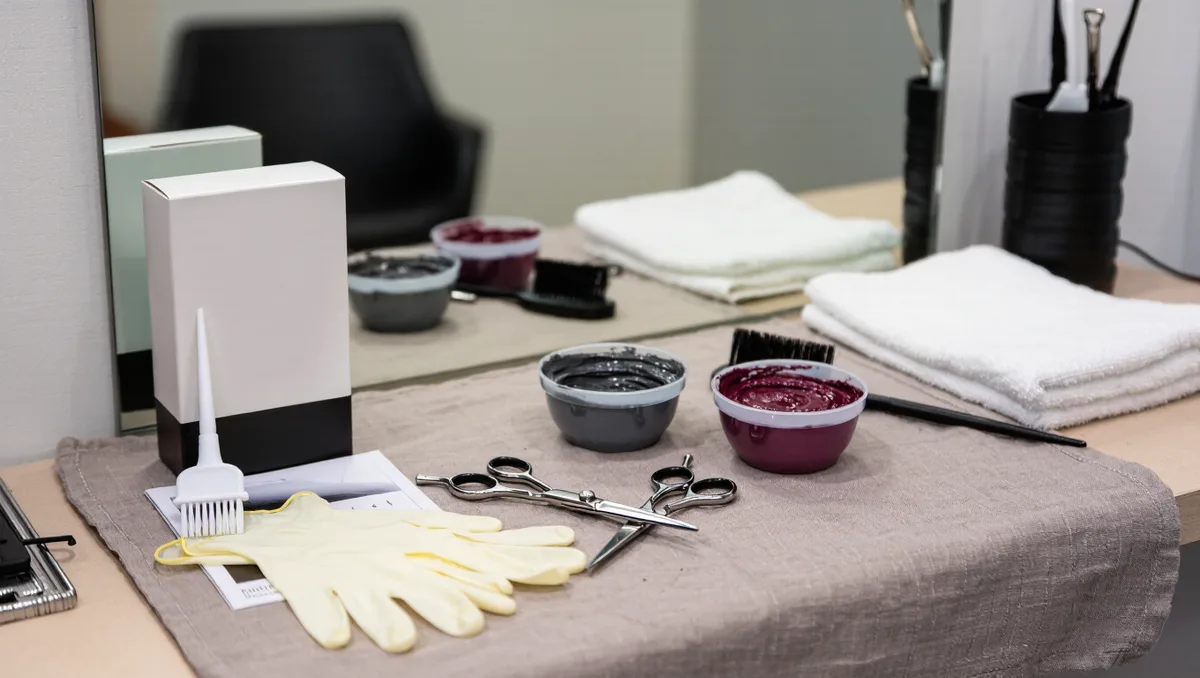
Salon color costs more than box dye, and it usually delivers more: a colorist can lift, correct, and blend in ways a one-size kit cannot. But the honest answer on cost is not a single number. It depends on how often you recolor, how complicated your target shade is, and how much correction work your hair needs before any dye touches it.
What follows is a cost-and-quality comparison built on how each route actually works, not on a fixed price list. Prices vary a lot by city and salon tier, so we have kept the math structural: what you pay for, what you redo, and where the damage risk sits. The goal is a decision framework that survives whatever your local rates turn out to be.
The short version: for a subtle refresh or a shade close to your natural color, box dye is the cheaper and often reasonable choice. For lightening dark hair, covering resistant grays, or fixing a color that went wrong, the salon route usually wins once you count the cost of repairing a bad box job.
What are you actually paying for at a salon?
A salon color appointment bundles three things: diagnosis, formulation, and application. A colorist looks at your underlying pigment, your gray percentage, and the condition of your hair before mixing anything. That first step is the part box dye cannot replicate, and it is why the same shade number can look right on one head and muddy on another.
The formulation is customized too. A professional can adjust developer strength, tone, and timing per section of your head. Application is even, saturated, and kept off areas that do not need it. You are also paying for the correction safety net: if the color lifts too warm or goes flat, a trained colorist can adjust it in the same sitting.
None of that is magic. It is labor and judgment, priced accordingly. A single-process appointment typically runs at a multiple of a box kit's price, and multi-process work like balayage or double-process blonding costs more still. The premium buys reduced risk, not a guarantee.
What does a box dye kit cover, and what does it skip?
A box kit is a standardized formula with a fixed developer strength and a fixed timing window. That standardization is its strength and its weakness. For going a shade or two darker, or refreshing a faded brown, it works predictably and costs a fraction of a salon visit. Many kits include gloves, conditioner, and enough product for thick hair, so the kit price is close to the true cost.
What it skips is assessment. The kit does not know that your ends are porous and will grab color faster than your roots, or that your gray strands resist dye and need more time. Porosity is how well hair absorbs liquid; porous hair soaks up pigment quickly and can turn darker or flatter than the box photo suggests. Standardized formulas handle average cases well and edge cases poorly.
The kit also skips correction. Box dye generally cannot lift old box dye, because the pigment layers stack. If the result is too dark or too warm, your options are limited until the color fades or a professional strips it. That correction visit is the hidden line item in the box-dye budget, and it is the one that erases the savings.
Where does the damage actually differ?
Damage tracks with developer strength and repetition, not with the brand of the tube. Both routes use hydrogen peroxide to open the cuticle so pigment can enter; higher strength means more lift and more structural wear. The difference is control. A colorist keeps strong developer away from already-lifted lengths. A box kit applies the same strength everywhere, every time.
This matters most for lightening. Lifting dark hair to blonde is a multi-step chemical process, and doing it repeatedly at home concentrates wear on the same strands. Over-processed hair feels gummy when wet, stretches without springing back, and eventually breaks. Repairing that is slow and expensive, which is why most professional advice about home bleaching is cautious.
For darker, deposit-only shades, the damage gap narrows sharply. Deposit color does little lifting, so a well-chosen box dye on healthy hair is a low-stress event. The honest comparison is that the damage tradeoff is mostly a lightening tradeoff.
What this means for your budget
Our analysis: build the comparison around regrowth, not around the sticker price. Root touch-ups are the recurring cost in both routes. Box dye users pay a small amount per cycle, many times a year. Salon clients pay a large amount per visit, fewer times a year. Over a full year, the salon route generally costs several times more for a single-process shade, and the multiple grows with every added process like highlights.
The deciding variable is complexity. Ask yourself one question: does my target shade require lifting my natural pigment, or only depositing onto it? Deposit-only goals are where box dye earns its keep. Anything involving lift, correction, or a big shade change is where the salon premium pays for itself in avoided repairs.
A hybrid strategy is common and rational: salon color to establish the shade, box dye or a root-touch-up kit to maintain it between appointments, and a salon visit when the color needs rebalancing. That pattern trades some of the salon's consistency for most of its savings, and it fails gracefully — a slightly flat mid-cycle color is fixable, while a botched full-head lift is not.
- Match the route to the job: deposit and refresh at home, lift and correct in a chair.
- Count correction risk as part of the box-dye cost, not as bad luck.
- Strand-test and patch-test every new kit, and time it honestly rather than optimistically.
- If your hair is already compromised, spend on condition first; dye holds better on intact hair.
Color is a maintenance habit, and the right route is the one whose recurring cost and recurring risk you can live with. If you want the broader context on how beauty pricing tiers are shifting, our beauty news desk tracks that closely. For the care side of the routine, see our guide to What snail mucin actually does, according to the research, and our breakdown of What the SPF number on your sunscreen actually means for reading labels with the same skepticism.
Where the honest comparison lands
The evidence for both routes is consistent: salons buy judgment and correction capacity, box dye buys affordability for simple jobs. What remains unknown is your own hair's behavior, and that is discoverable cheaply — one strand test tells you more than any general guide. Start there, match the route to the complexity of the job, and let the recurring math, not the first receipt, make the decision.