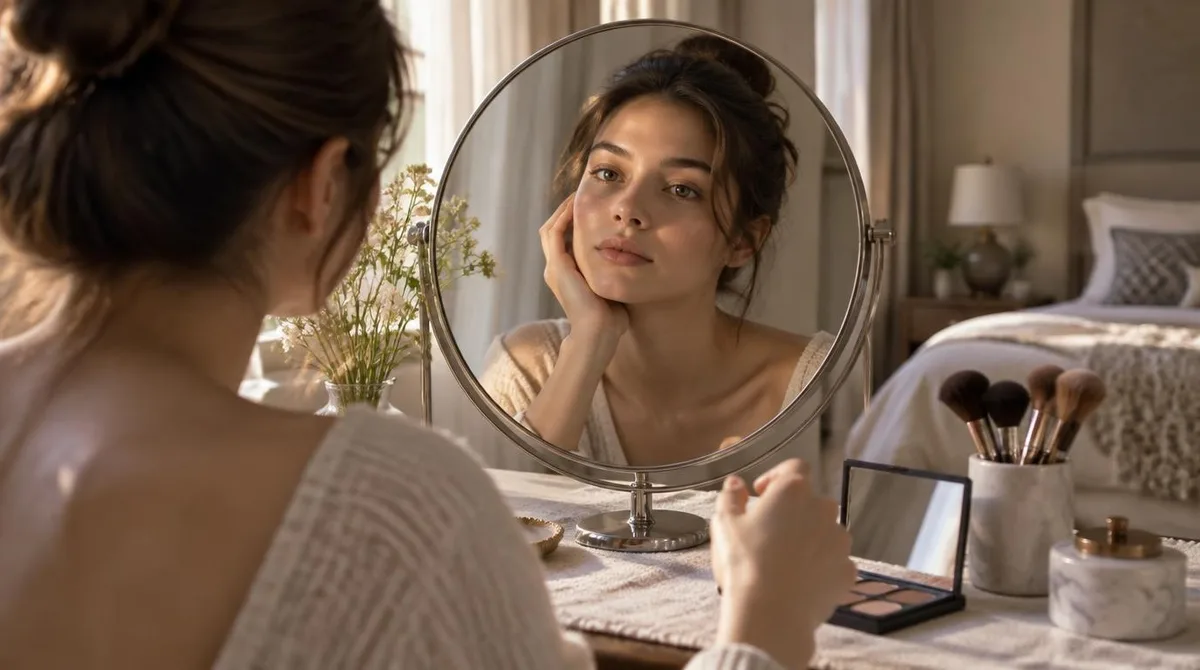
Women who skip makeup are often described as less interested in external validation and quietly more confident. That is the framing of a recent Times of India piece on the psychology of makeup use. The research it draws on supports a narrower version of that claim: comfort without cosmetics may signal less dependence on appearance-based approval, but the evidence on self-esteem and makeup is genuinely mixed.
The more useful takeaway is not about who wears makeup and who does not. It is about the difference between choosing cosmetics and needing them. That distinction, not the bare-faced face itself, is what the studies keep circling. For readers who follow beauty news, it reframes how to read any headline about what your routine supposedly says about you. We covered a connected angle in Patrick Ta and NikkieTutorials' pre-makeup routine, translated into steps you can actually follow.
What the studies actually found
The research behind the article is small and older than the headline implies. One experimental study, 'Makeup and its application simulation affect women's self-perceptions', published in the journal Archives of Sexual Behaviour in November 2021, followed 50 Brazilian women. Participants saw themselves with and without makeup, applied by a professional. They described themselves as more feminine and more attractive after application, and reported higher self-esteem and more satisfaction with their appearance.
An earlier study, 'Effects of cosmetics use on the physical attractiveness and body image of american college women', published in 1989 in the Journal of Social Psychology, pointed the same way. American college women rated themselves as more attractive in their usual makeup than without it.
So makeup can lift how a woman sees herself, at least in the moment. The Times of India piece also notes the reverse pattern: some research finds women reach for cosmetics more often when they feel less physically attractive. Makeup, in that reading, becomes a tool for managing how others are expected to see them.
Why the confidence link is not settled
Here is where the headline outruns the evidence. Research on whether heavier makeup use tracks higher or lower self-esteem has produced conflicting results. One study of 30 British undergraduate women found a negative relationship: women with lower self-esteem tended to wear more makeup. Other participants in the research showed a positive association. Readers following this should also see Fabric Durability Expectations — Pilling, Fading, and Wear: What to Expect From Different Fabrics Over Time.
The article attributes those contradictions to the cultural and demographic backgrounds of the participants. That is the honest reading. Makeup habits alone cannot tell you how confident a woman is, and a sample of 30 undergraduates cannot settle a question about half the population.
What the evidence does allow is a possibility, stated as one: women who are comfortable appearing without makeup may depend less on cosmetics to feel attractive or socially accepted. They may feel freer to present themselves as they are, rather than measuring their faces against other people's expectations. That is a plausible interpretation, not a proven rule.
The distinction that actually matters
The sharpest idea in the research is the gap between enjoying makeup and feeling unable to go without it. A woman who wears lipstick because she loves the shade is expressing a preference. Someone who feels anxious about being seen without foundation is dealing with appearance-related pressure. The same product, two different relationships.
The researchers also found that their questionnaire could predict self-objectification, along with concerns about body shape and weight. Self-objectification means judging your own appearance from an outsider's point of view — constantly asking how others might see and assess your body. It suggests the pressure to look a certain way reaches past the vanity table and into how women perceive themselves at all.
For anyone comfortable going without makeup, the article argues, not feeling forced to meet those expectations may be a real part of their confidence. That is the defensible core of the 'deep underlying confidence' claim.
What this means for how you read beauty coverage
Treat routine-as-identity headlines with care. The studies cited here are small — 50 women, 30 women — and one dates to 1989. They describe tendencies in specific groups, not laws about women in general. The honest summary is that makeup can offer a temporary confidence boost, that lower self-rated attractiveness sometimes tracks heavier use, and that the self-esteem link runs in both directions depending on who was studied.
The practical question for a reader is not whether makeup is good or bad. It is whether the routine is a choice or a source of reassurance. If it is a choice, there is nothing to fix. If skipping it brings anxiety, the research suggests the pressure underneath is worth noticing — because it is about validation, not cosmetics.
None of this changes what belongs in a makeup bag. It changes what a routine is for. Makeup as self-expression is one of the genuinely joyful parts of beauty. Makeup as a prerequisite for facing the world is the part worth questioning, and the research gives language for that difference: choice versus reassurance.
Where the research goes next
The open question is cultural. Because results flip depending on participants' backgrounds, no single study can describe how makeup and confidence interact across contexts. Until larger and more varied samples exist, the fair reading is modest: comfort without makeup may reflect less dependence on external approval, and feeling required to wear makeup may reflect appearance pressure rather than preference. Both are worth knowing before the next headline tells you what your face means.