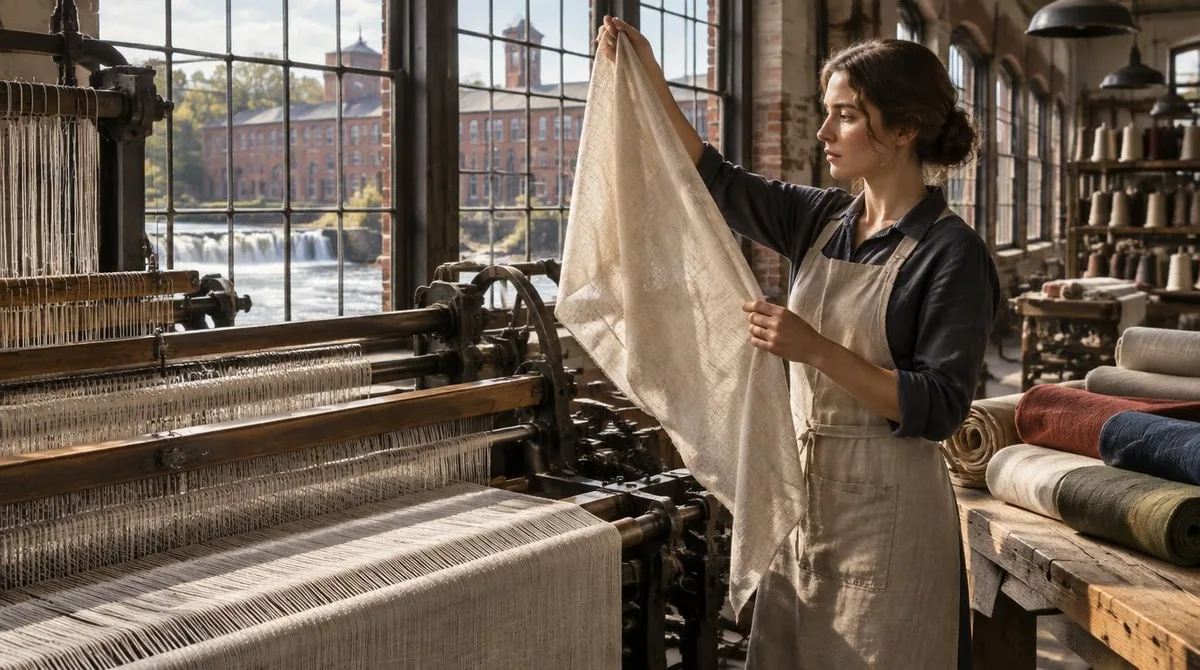
A mill that has stayed in one family for generations is not a museum. It is a working building, with looms that run on schedule and a payroll that has to be met. The interesting question is not nostalgia. It is what a small regional mill does differently from a global supply chain, and why the difference shows up in the cloth you buy.
The short answer: proximity. When spinning, weaving, dyeing and finishing happen under one roof, the people making the fabric can check it at every stage. Problems get caught early. Runs stay small. And the fabric that leaves the building carries the habits of the people who made it. That is the thread this piece follows — what mill history explains about the clothes in your wardrobe, and how to shop that history without a romantic budget.
Why New England built its towns around mills
Textile mills need three things in one place: moving water, workers and a way to ship cloth out. New England had all three. Rivers offered power before electricity did, so mill villages grew up along the water — rows of brick buildings, company housing, a canal to turn the wheels. The town and the mill were one economy. If you have ever visited a New England river town and wondered why the main street faces a dam, that is the reason.
Over the past century, most of that production moved south, then overseas, chasing lower labor costs. The buildings stayed; the looms mostly did not. What remains is a thin tail of small operations — some family-run, some worker-owned — that survive by doing what the big mills cannot. They take short runs. They weave specialty yarns. They fix a problem the same afternoon instead of the same quarter.
We think of this as the practical core of fashion-news coverage that rarely makes headlines: the quiet infrastructure behind what hangs on a rack. When regional production disappears, the loss is not just jobs. It is knowledge — how a wool behaves on a loom, how a dye lot shifts with the seasons — held by fewer and fewer hands.
What a small mill does differently
Scale changes everything about fabric. A large mill optimizes for consistency across enormous runs, which is a genuine achievement and mostly what the market asks for. A small mill optimizes differently. It can afford to weave a few hundred yards of something unusual, because the overhead is measured in family labor and a building already owned.
That shows up in three ways a shopper can actually notice:
- Hand and drape. Cloth woven on older machines, at slower speeds, often has a slightly loomer, softer hand. It is the difference between fabric that falls and fabric that stands.
- Traceability. Ask a small mill where its yarn came from and you usually get a name. Ask the same question across a multi-country supply chain and you get a shrug.
- Repairability. Short runs mean the maker still has the yarn lot. A snagged sweater or a torn panel is more likely to be fixable, because matching material still exists.
This is also why mill cloth tends to age better. We have written before about Fabric Durability Expectations — Pilling, Fading, and Wear: What to Expect From Different Fabrics Over Time, and the pattern holds: fiber quality and finishing choices made at the mill decide most of how a garment wears, long before a customer touches it. We covered a connected angle in Fabric Durability Expectations — Pilling, Fading, and Wear: What to Expect From Different Fabrics Over Time.
How to read a garment label like a mill town local
You do not need to visit a mill to benefit from one. You need to read labels with a little more suspicion and a little more curiosity. Here is the practical version.
First, look for named origins. "Woven in Portugal" or "fabric milled in the USA" tells you the cloth was made somewhere accountable, not just sewn there. Second, look for named mills. Some brands print the mill's name on the label or the hangtag, the way a winery prints its vineyard. That is a good sign — it means the mill's reputation is part of the product. Third, price it honestly. Mill-made cloth costs more because it is made in shorter runs with more human checking. A mid-tier merino sweater from a named mill will not compete with fast-fashion pricing, and it should not pretend to.
Our analysis: treat mill origin as a proxy for construction intent. Brands that name their mills tend to name their factories too, and the whole garment gets more legible. If you want a checklist for the rest of the garment — seams, hems, pattern matching — our guide to Clothing Construction Quality: How to Identify Quality Seams and Construction Before You Buy covers the inspection part in detail. Readers following this should also see Clothing Construction Quality: How to Identify Quality Seams and Construction Before You Buy.
The word "cover" and the stories we tell about making
A small language note, because it matters for how these stories get told. The word "cover" does a lot of work in English — The Free Dictionary lists dozens of senses, from a bedcover to a magazine cover to the act of concealing something. A cover story about a mill sits in that same spread of meanings: the magazine sense, and the sense of covering ground — of traveling over real distance to see a real place. It is worth keeping both in mind. A profile of a working mill should cover the floor, not just the romance.
That is also the honest limit of pieces like this one. Without time on the floor — watching a loom, asking about a dye lot — a writer can describe the system but not the specific building. The general claims above are durable. The specifics of any single mill deserve the reporting trip itself.
What this means for your wardrobe
Mill history is not a shopping instruction. It is a lens. Once you know that cloth comes from somewhere — a river, a family, a particular loom — you start asking where yours came from, and the answer changes what you are willing to pay. You also stop treating a garment as disposable. Fabric with a traceable origin is fabric worth mending, and mending is a skill, not a sacrifice.
None of this requires a bigger budget, only a slower one. Buy fewer, heavier things. Check the seams. Keep the receipt of knowledge, not just the paper one. And when a label names the mill that wove it, read that name the way you would read a signature — as someone standing behind the work.
The takeaways worth keeping
Regional mills survive by doing what large ones cannot: short runs, traceable yarn, same-day fixes. That difference is visible in the hand of the cloth and the honesty of the label. New England's mill towns explain why the region's fabric history runs so deep — water, workers, shipping — and why so much of it left. What remains is small, skilled and worth seeking out, one named mill at a time.
The evidence for how fabric ages supports the case for buying mill-made when the budget allows: fiber and finishing choices made upstream decide most of a garment's lifespan. The rest — fit, care, repair — is yours to learn, and it is learnable. That is the part we keep coming back to: fit is a skill, and so is shopping. Both improve with attention.