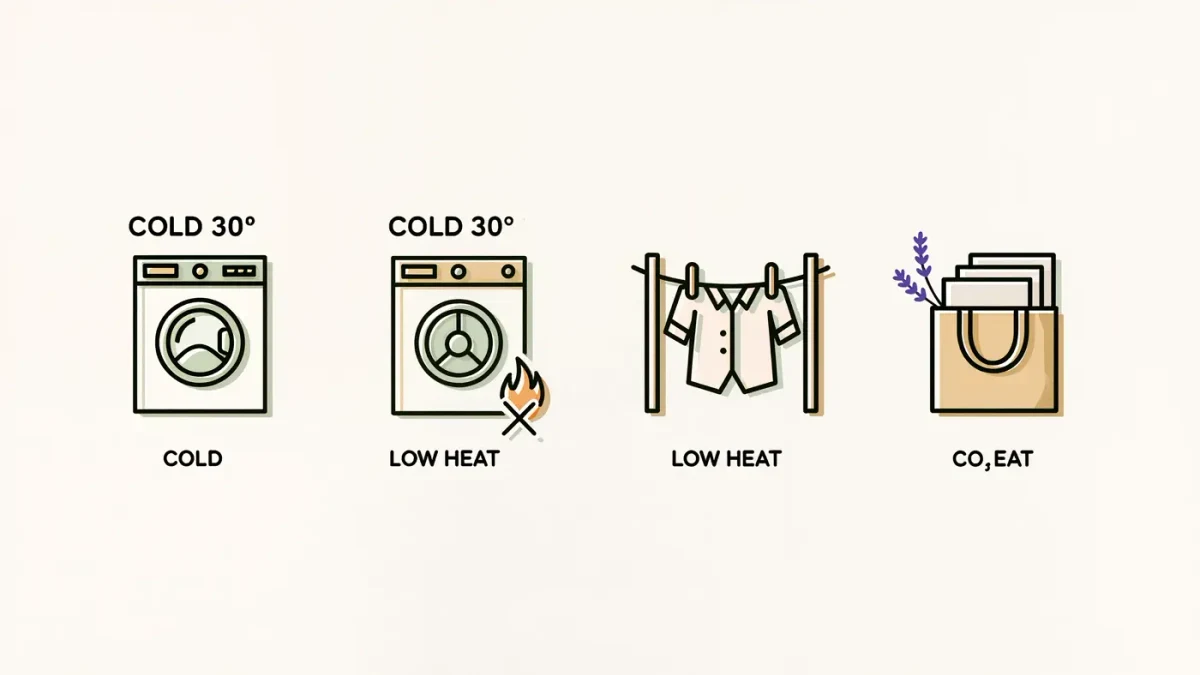
Wool shrinks in the wash for one reason: heat and agitation lock the scales on each wool fiber against each other, a one-way process called felting. Wash wool in cool water, with a pH-neutral detergent, with as little motion as possible, and dry it flat — those four conditions are the whole method, and they work equally for merino, lambswool, and cashmere. Start with the soak-and-press hand wash below; it is the version with the least friction, and it takes about 30 minutes of mostly waiting.
Zebule publishes information, not laundry or product advice; these are widely accepted home practices, and when a garment's own care instructions conflict with them, the garment's instructions win.
Why does wool shrink, and can it be undone?
Wool fibers have overlapping scales like roof shingles. Warm water, alkaline soap, and rubbing make the scales grab neighboring fibers and migrate tighter — felting — which shrinks and stiffens the knit permanently. Fulling can be eased slightly by soaking in hair conditioner and gently re-blocking, but a felted sweater never returns to its original hand. That asymmetry is why prevention is the entire game: every step below exists to keep the scales lying flat.
How do you hand wash a wool sweater?
- Fill a basin with cool water — comfortably cool to the touch, never warm — and add a wool detergent or a drop of pH-neutral shampoo. Wool's own fiber is keratin, the protein in hair, which is why hair shampoo is the accepted substitute. Skip regular laundry detergent entirely: most are alkaline and strip the fiber.
- Turn the sweater inside out and submerge it, pressing it under until saturated. Let it soak 10 to 20 minutes. Dirt releases into the bath during the soak; agitation is what makes scales grab, so stillness is a feature, not laziness.
- Press the sweater against the basin sides a few times — squeeze, never rub, never wring. If one area is soiled, squeeze the soapy water through it repeatedly instead of rubbing fabric on fabric.
- Rinse in two changes of cool water at the same temperature as the wash. A sudden temperature shift is itself a felting trigger, so the rinse must match. Squeeze — do not hold under a running tap, whose pressure agitates.
- Press water out flat, then roll the sweater in a dry towel like a sleeping bag and press along the roll. The towel takes most of the water so the drying step takes hours, not days.
- Dry flat on a fresh towel or a mesh rack, reshaping to original dimensions. Measure the shoulders and length against a similar dry sweater and adjust now — wet wool is pliable for a short window. Dry away from sun and radiators; drying flat is what prevents the hanger-stretch that ruins shoulders.
The method changes nothing about the sweater except its cleanliness — that is the goal. Skip the towel step only for gauzy knits that might snag on terry loops; press them gently between two towels instead.
Can you machine wash wool?
- Use the wool or delicate cycle at 30 degrees Celsius or colder, with the spin capped low — 600 rpm or less if your machine allows. High spin crushes the knit against the drum and sets creases.
- Put each sweater in a mesh laundry bag and wash only with other wool. Zips and buttons from mixed loads are the main source of pulls and pills in an otherwise correct wash.
- Use wool detergent, dose for soft water if unsure, and skip fabric softener — softeners coat the fiber and reduce wool's natural temperature regulation, the property you bought it for.
- Reshape and dry flat exactly as in the hand-wash method. The machine cycle replaces the soak and pressing, never the drying. Skip the dryer entirely unless the garment's label explicitly permits tumble — and note that 'low heat' tumble settings still felt some wools.
Machine washing changes the risk profile: a correct wool cycle is safe for most modern knits, but one wrong mixed load can felt everything in the drum, so the bag-and-sort discipline is what carries the method.
How do you fix a stretched or shrunken sweater?
A stretched sweater — the hanger or gravity kind — is recoverable: soak it in cool water with a capful of hair conditioner for 20 minutes, press out the water in a towel, then dry flat, worked back toward its original measurements as it damp-dries. A shrunken, felted sweater is not: the scales have locked. You can soak and re-block it to regain maybe a few percent and a softer hand, but treat a felted knit as a loss and, better, a lesson in which step was skipped — almost always warm water, a hot dryer, or agitation.
How often does wool need washing at all?
Far less than cotton: wool resists odor because its fibers absorb and neutralize moisture, so airing a sweater flat or on a wide hanger overnight resets it for most wears. Wash when it is visibly soiled, after heavy sweat, or roughly every five to seven wears for a base layer — fewer for a cardigan. Between washes, rest the knit a day between wears; the fiber's own recovery does most of the maintenance work you were about to attempt with water.
Sources for this piece include the FTC's care labeling requirements for textiles.