Ask why one outfit looks composed and another looks assembled, and the answer is rarely the price tag. It is proportion: the ratio of volumes, lengths, and widths across the body. A $40 tee over wide trousers can hold together better than a four-figure look because the volumes agree. This column argues that proportion is the single most learnable tool in dressing — more useful than color theory, more reliable than trends — and it starts with one habit: reading outfits as blocks, not items.
We should be clear about what this is. Zebule publishes information, not styling advice for any individual; what follows is a framework drawn from how stylists, costume designers, and illustrators have described the figure for decades, offered as a way of seeing rather than a prescription for any body.
What does proportion actually measure?
Not height, not weight — division. Every outfit splits the body into segments: shoulder to waist, waist to knee, knee to floor. Proportion is the relationship between those segments. Classic tailoring encoded one version of it: a jacket that ends near the thumb knuckle, trousers that break once, a shirt collar sized to the neck. But proportion operates in casual dressing too, whether you have thought about it or not.
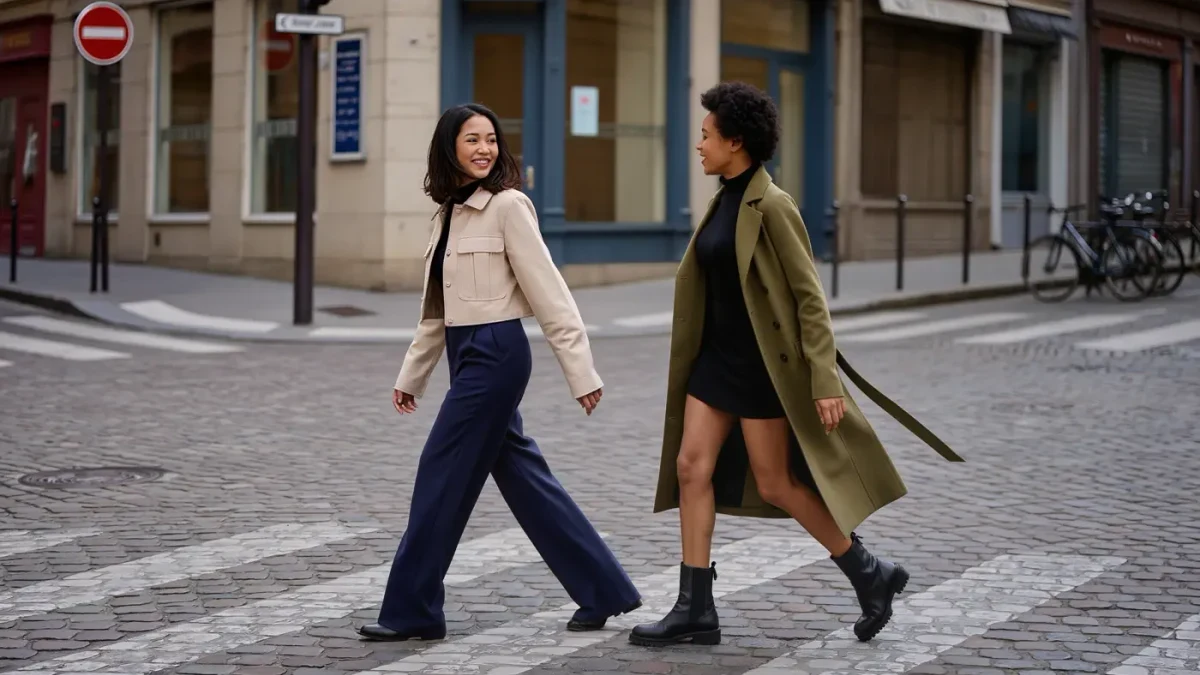
Consider the outfit that launched a thousand imitations: a boxy top over a slim bottom, or the reverse. Both work for the same reason. The eye reads a single dominant volume against a secondary one. Trouble begins when every piece occupies the middle ground — a mid-crop top over mid-rise, straight-leg trousers with a mid-length cardigan over the top. Nothing dominates, so nothing organizes. The result is not ugly; it is unreadable.
The 1:2 idea, and why it keeps returning
Designers outside fashion have used asymmetric ratios for centuries. Painters placed horizons at one-third; architects divided facades unevenly on purpose. Dressing borrows the same logic. A look reads as composed when one segment is roughly twice another: a long coat over a short hem, a cropped jacket over full-length trousers, a tucked shirt that sharply divides the body against wide volumes below. Stylists call this the rule of thirds; we think of it as giving the eye a decision already made.
Notice the specific, unglamorous tool hiding inside the principle: the tuck. A full or half tuck is a proportion device before it is a tidiness device. It moves the waistline, and moving the waistline re-divides the body. Few adjustments change an outfit for less effort.
Volume balance, or why wide needs a counterweight
The second axis is width. Wide-leg trousers, oversized knits, and sweeping coats each occupy space honestly — the mistake is letting them do it alone. A wide volume asks for a fitted counterweight somewhere in the outfit: a lean sleeve, a tucked front, a close collar. When everything is roomy, the figure disappears into the clothes; when everything is close-cut, the outfit can read rigid. Fashion illustration has taught this for a century, and the reason it survives as a discipline is that silhouette balance is visible before any detail is.
How do you diagnose proportion without a mirror spiral?
Try a three-step check borrowed from how stylists review fittings. First, squint — literally or metaphorically. Blur the details and look at blocks of light and dark: is there one clearly larger block? Second, find the waistline decision: where does the eye believe the body divides? If you cannot locate it, the outfit's segments are competing. Third, check the hem-to-shoe gap. A sliver of visible ankle or a clean full-length line both work; the ambiguous four-inch break is where most casual looks quietly fail.
None of this requires buying anything. It does require tolerating a week of looking rather than shopping — observing which outfits you already own hold together and asking why. The pattern usually appears within days: one dominant volume, one clear division, one deliberate counterweight.
Why proportion outlasts every trend cycle
Trends rotate through color, print, and cut, but the mechanics underneath stay fixed because they belong to visual composition, not commerce. A cropped jacket was proportionally correct in 1962 and again in 2025; what changed was the sleeve, the fabric, the context. Readers who internalize the ratio stop chasing each silhouette's arrival and start recognizing which versions of it will work on them. That is the quiet advantage this column keeps returning to: the eye is the only piece of the wardrobe that never wears out, and proportion is where training it pays first.
The close of the argument is the thesis restated: price signals intent but never executes it. Proportion executes it — one dominant volume, one decisive division, one counterweight. Everything else in the outfit is negotiable.
Sources for this piece include open-access art and design collections at the Smithsonian.