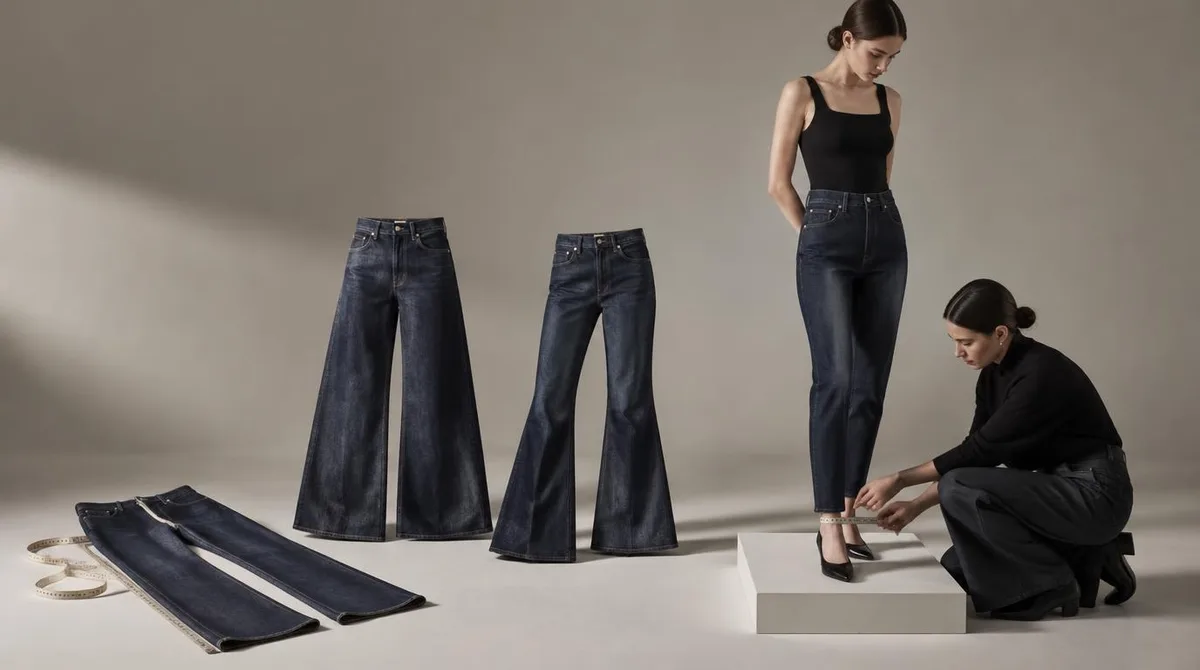
There is no single jean cut that suits everyone. There is a cut that suits your proportions, your height relative to the rise you like, and the shoes you actually wear. This denim fit guide maps the four main cuts — straight, wide, bootcut, and tapered — to what each one does visually, so you can shop by shape instead of by trend cycle.
The good news is that most of the decision is arithmetic, not taste. A jean's effect on your silhouette comes down to three measurements: the rise (where the waistband sits), the leg opening (how wide the hem is), and the inseam (how long the leg is). Retailers publish these numbers, and once you read them, the jeans wall stops being intimidating.
What do the measurements on a jean listing actually tell you?
Three numbers do most of the work. The rise tells you where the waistband lands on your body — low rise sits well below the navel, mid rise near it, high rise above it. The leg opening, measured flat across the hem, tells you how much fabric pools at your ankle. The inseam tells you where the hem falls on your leg.
These numbers vary a lot between cuts, and retailers publish them so you can compare. Pacsun's denim fit comparison lists, for example, a straight fit with a 31-inch inseam and a 20.5-inch leg opening, a wide fit with a 19.5-inch leg opening, and an oversized fit with leg openings of 23 and 27 inches. That spread — from roughly 15 to 27 inches at the hem across their range — is the whole difference between a lean silhouette and a dramatic one.
Our analysis: start shopping by leg opening, not by cut name. Names drift with trends; the measurement on the listing does not.
How do you match a jean cut to your proportions?
Think in terms of balance. A wide leg opening adds visual weight at the hem, so it pairs naturally with a defined waist or a tucked top — the volume needs an anchor. A narrow leg opening does the opposite: it slims the lower line, which reads clean under longer layers but can make a fuller hip look pinched if the rise is too low.
Height matters less than people fear, because inseam is adjustable. What you cannot tailor cheaply is the rise. If a rise sits wrong on your torso, no hem will fix it. Proportion, not price, is why some outfits hold together — and the same logic applies at the denim wall, as we argued in our piece on why proportion makes an outfit work.
A short practical sequence:
- Measure your best-fitting pair. Lay it flat. Record rise, leg opening, inseam. That is your baseline.
- Decide what you want to change. More length? More volume? A cleaner ankle line?
- Shop the measurement, not the name. Compare the listing numbers to your baseline.
- Plan one alteration. A hem is inexpensive; a rise reconstruction is not.
Straight, wide, bootcut, tapered: which cut does what?
Here is the taxonomy in one table, with the trade-off each cut makes.
| Cut | What it does | Suits | Watch out for |
|---|---|---|---|
| Straight | Even width from hip to hem; the neutral of the group | Nearly everyone; the safest first good pair | Can read plain — the shoe carries it |
| Wide | Volume through the whole leg; strong horizontal line at the hem | Taller frames, or anyone pairing with a fitted top half | Overwhelms a petite frame unless hemmed precisely |
| Bootcut | Snug through the thigh, flares below the knee | Balancing fuller hips; wearing with boots or a heel | Wrong hem length breaks the vertical line |
| Tapered | Narrows from knee to hem; clean, close line | Layered looks, shorter hems, showing the shoe | Tight taper can pinch a muscular calf or fuller thigh |
Straight is the cut we recommend first to anyone rebuilding a wardrobe. It flatters by refusing to make a statement, which means it works with the rest of your clothes instead of competing with them. Wide-leg jeans, by contrast, are a composition choice — they announce themselves, and the rest of the outfit has to make room. The same logic we applied to negative space in an outfit applies here: wide denim creates volume, and volume needs somewhere to breathe.
Bootcut is the quiet workhorse. The flare below the knee adds a few visual inches of leg and balances the hip line, which is why it has never really left. Tapered is the modern default for a reason: it ends the leg cleanly and lets the shoe do the talking — a point we made in our argument that an outfit actually starts with the shoes.
What should you check before buying, beyond the cut?
Four checks, in order of how hard each is to fix later.
- Rise. Sit down in the fitting room, or at home with tags on. A rise that gapes when you sit will never behave.
- Hip and thigh. Denim has almost no stretch at the waistband seam. If it digs now, it will dig after every wash.
- Inseam versus your shoe. Try the jeans on with the shoes you will actually wear. A straight or wide cut hemmed for sneakers will float over flats.
- Fabric weight. Heavier denim holds a wide leg's shape; a lightweight wide jean collapses and drapes like a pyjama pant. That can be a look — but decide it on purpose.
Sizing itself is its own puzzle. Women's sizing runs on waist-and-hip numbers while men's runs on waist and inseam — Pacsun's size guide, for instance, lists women's sizes from a 23-inch waist with a 34.5-inch hip upward, and men's jeans as paired measurements like 32 x 32. Knowing your two numbers in inches lets you shop either wall.
When is tailoring worth it — and when is it not?
Tailoring is worth it when the jean is right everywhere except the hem, and when you have found a cut you will re-buy for years. A hem on a straight or tapered jean is a simple, inexpensive job. A taper added below the knee is moderately harder. Anything touching the rise, the seat, or the waistband on denim is expensive, because the waistband construction is built to hold shape.
Our rule: budget the alteration into the price of the jean before you buy. A mid-priced pair plus a hem often beats a cheap pair worn at the wrong length. We make the fuller case in why tailoring beats buying new. We covered a connected angle in Clothes Fit Tailoring — Fit Is Everything: Why Tailoring Beats Buying New.
Denim does not have to stop at jeans, either. A denim shirt is the same fabric working in a different silhouette — one cotton men's denim shirt listed on Amazon's denim section at $33.29 with a coupon at the time of the listing shows how budget-friendly the category can be — and layering it under or over your jeans is where the stylist's approach to layering earns its keep. Match the weight: a heavy shirt over a light jean reads top-heavy.
What this means for your next pair
The evidence of the measurements is clear: cut names are marketing, measurements are facts. Find your baseline pair, write down its three numbers, and shop the gap between what you have and what you want. Silhouettes date faster than colors — a point we developed in why silhouettes date faster than colors — so the durable strategy is to own the cut that fits your proportions and let trends visit briefly.
What remains unknown is only the personal part: how a given rise sits on your torso, how a given hem breaks over your shoe. No guide can settle that. But with the numbers in hand, you can settle it in one fitting room instead of six.