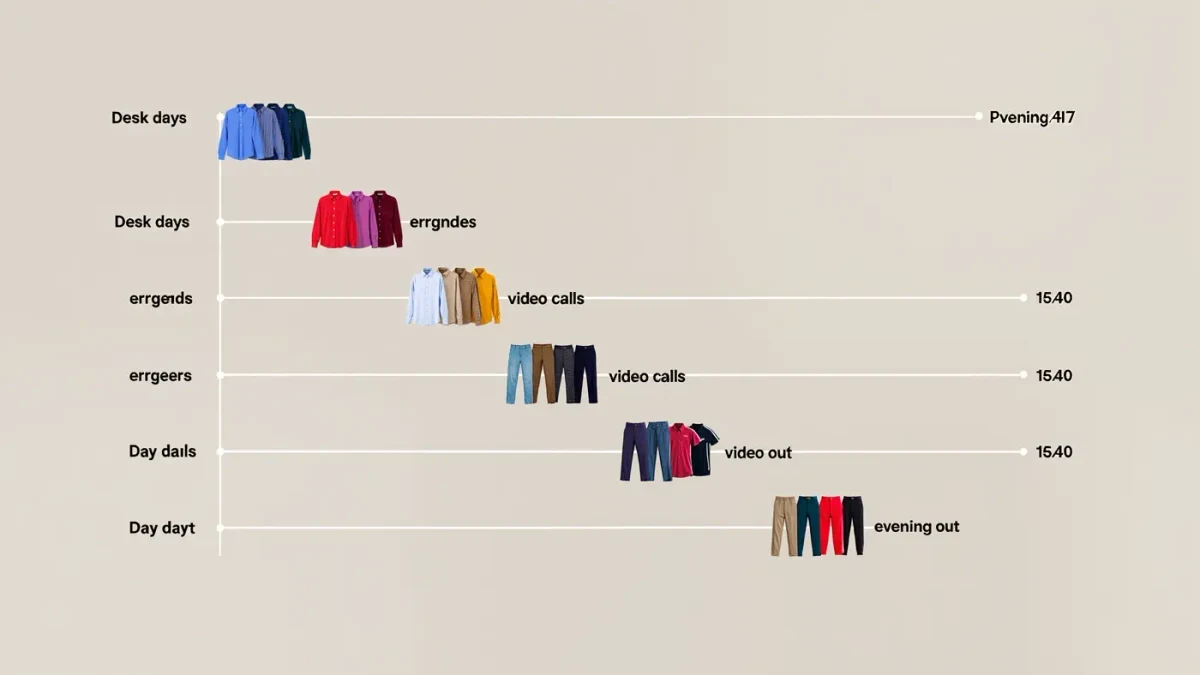
Here is an uncomfortable audit: write down last week's actual activities — commutes, desk hours, a grocery run, two video calls — then open your closet and count the garments built for that list. Most people find the closet answers to a different, more glamorous week: dinners out, weddings, occasions. Wardrobes are routinely built for a calendar the owner wishes they had, which is why the thing hanging closest to the door so often goes unworn. This column argues that dressing well starts with scheduling, not shopping: map the real week, then make the wardrobe answer to it.
The claim is practical, not personal — no diary anecdotes here, just a method the desk has assembled from wardrobe-audit practice documented by professional organizers and stylists.
Why does the fantasy calendar problem happen?
Because shopping is event-driven and wearing is routine-driven. Retail gives its most compelling floor space to occasion wear precisely because occasions trigger purchases; a Tuesday commute sells nothing. Meanwhile the actual week — the one made of desk chairs, transit, and errands — repeats roughly fifty times a year, and each of those days still asks for an outfit. When 80 percent of your hours live in one narrow context and most of your closet lives in another, the mismatch guarantees the daily feeling of having nothing to wear surrounded by clothes.
The numbers make the case concretely. A standard work year holds about 250 working days against perhaps a dozen genuine occasions. Yet occasion pieces and their adjacent fantasy purchases routinely claim a third of many closets. The wardrobe is not understocked; it is misallocated.
How do you audit for your real week?
Three steps, one evening. First, list your actual recurring contexts from the last month: the honest categories might be desk-plus-commute, video calls, errands, gym, and one social slot — with percentages of your waking hours. Second, assign each context a share, even roughly: if 60 percent of days are desk days, 60 percent of the closet should serve desk days without apology. Third, pull out everything that serves no context you lived in the past month — the hypothesis to test, not necessarily to discard — and set it aside for a season. What returns to rotation stays; what does not has told you something.
The output is not a minimal wardrobe, note well. It is an accurately weighted one. Someone whose week is genuinely half evenings-out should own evening clothes in proportion; the method argues for accuracy, not austerity.
What does a correctly weighted closet change?
Two daily frictions disappear. The first is decision fatigue: when the ratio of clothes to contexts matches, nearly everything hanging there is wearable for the day at hand, so the morning question stops being a filtering problem. The second is guilt — the quiet tax of the unworn occasion dress and the too-fancy coat, each reminding you of a life you are not currently living. Dressing for your real calendar is, plainly stated, permission to stop costuming for it.
It also changes what buying means. The question before any new piece shifts from “is this nice?” to “which of my contexts is this for, and is that context under-served?” A excellent blazer is a bad buy for someone with zero blazer hours and a great one for someone with forty. Same garment, opposite verdicts — which is why generic shopping advice fails and personal auditing works.
Laundry arithmetic closes the loop, and it is the step most audits skip. A context’s share of the week must be divided by how often its clothes cycle between washes: desk outfits that get four wears before laundering need only a quarter as many pieces as gym kits washed after every session. A wardrobe can be perfectly weighted in ratio and still fail in volume — six desk outfits at a 60 percent desk share mean wearing each twice before wash day, which some weeks is exactly the margin that runs out. Counting cycles as well as contexts is what turns the audit from a tidy diagram into a schedule that survives contact with Thursdays.
What about the occasions that do come?
Keep a deliberate small reserve: one outfit per genuine recurring occasion, chosen to work for several kinds at once. The reserve exists on purpose, sized to the calendar's actual event frequency — and its limits are the point. When a rare event arrives, renting or borrowing is a legitimate answer for one-off dress codes, a service the market now supplies at every price point. The wardrobe answers to the week; the rental answers to the wedding.
The thesis at the close: style is a supply chain, and supply should answer to demand. Your calendar is the demand. Audit it before the next purchase, and the closet will finally start working for the life you are actually living.
Sources for this piece include BBC Culture's essays on dress and everyday life.