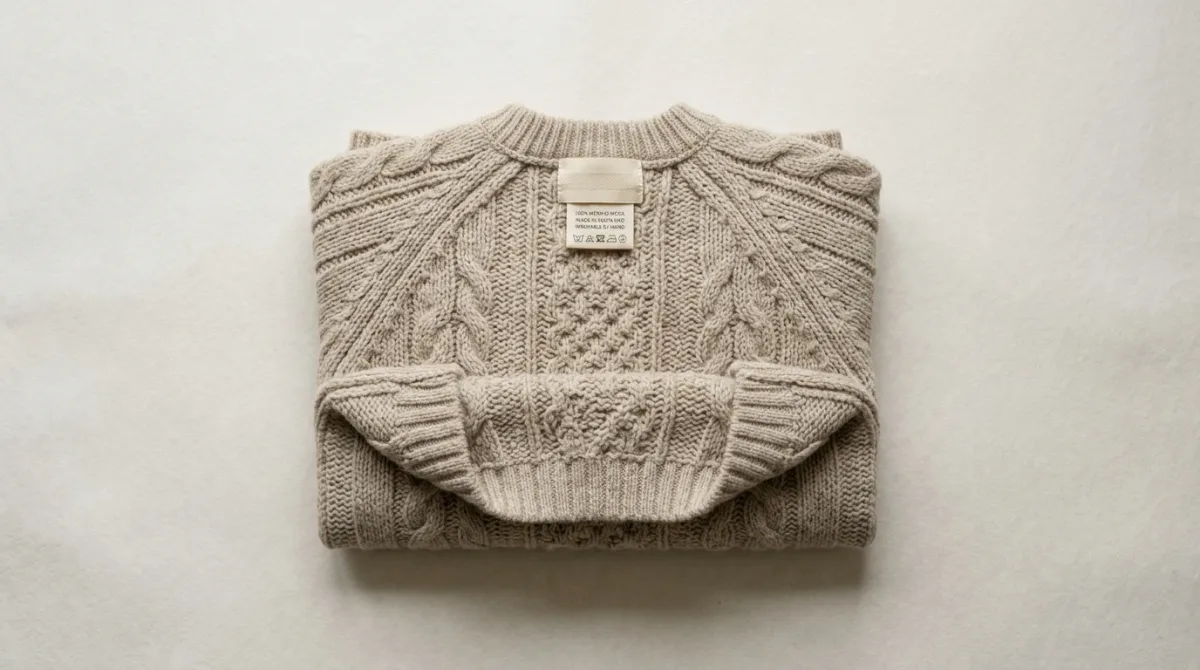
A clothing label is a compliance document before it is anything else, and that is what makes it worth reading. Federal rules force it to name the fibers by weight, the country of origin, and the company that stands behind the garment — and to reserve the word cashmere for fibers averaging no more than 19 microns. It is the cheapest research a shopper gets.
Most of us learn to read the price tag fluently and the care tag not at all. Reverse that order and the fitting room becomes a different room: less guessing about whether a sweater will survive a winter, more evidence.
What is a clothing label legally required to tell you?
Three things. According to the Federal Trade Commission's guidance on the Textile and Wool Acts, a textile product must disclose its generic fiber content by percentage, its country of origin, and the identity of the manufacturer or importer — either a company name or an RN number.
The FTC also requires that these disclosures be “clearly legible, conspicuous and readily accessible,” set in lettering of equal size, and placed in immediate proximity to one another. A brand that buries fiber content in smaller type than its logo is not making a design choice. It is out of step with the rule.
The wool vocabulary is regulated more tightly than the rest. The FTC defines wool as fiber from sheep or lamb fleece and from the hair of the Angora goat, Cashmere goat, camel, alpaca, llama, or vicuna. Recycled wool means wool returned to a fibrous state after having been woven, knitted, or felted. Cashmere must be the fine dehaired undercoat of a Cashmere goat, must average no more than 19 microns in diameter, and must contain no more than three percent by weight of fibers exceeding 30 microns. Those are not marketing adjectives. They are thresholds.
Why does the order of the fibers matter more than the names?
Because the list runs in descending order of predominance by weight, the first fiber tells you what the garment mostly is, and the second usually tells you how it will behave. A coat that reads 70% wool, 30% polyester is a different object from one that reads 30% wool, 70% polyester, even though both put wool on the label.
Two footnotes change how you read the percentages. Fibers under five percent are generally designated as “other fiber” rather than named — with wool and recycled wool named regardless of amount, and fibers of “definite functional significance” permitted to be named below the threshold. That last exception is why a three percent spandex content appears on a trouser label: it is doing work, and the maker wants credit for it. There is also a three percent tolerance on fiber content claims, so treat a stated percentage as a close approximation rather than a measurement.
What do the fiber names predict about how a garment wears?
More than most shoppers expect. The behavior of a fabric is largely set by its fiber before a single seam is sewn — how it creases, whether it pills, whether it holds odor. University of Georgia Extension's fiber primer lays out the trade-offs plainly, and they are worth carrying into a store.
| Fiber | What it does well | Where it disappoints |
|---|---|---|
| Cotton | Durable, absorbent, comfortable | Wrinkles unless treated |
| Linen | Strong; wicks moisture and dries quickly | Wrinkles badly; color frosts along creases |
| Wool | Wrinkle resistant; absorbent and water-repellent | Vulnerable to moth and beetle damage |
| Silk | Strong; moderately wrinkle-resistant | Weakened by sunlight and perspiration; absorbs body oils |
| Rayon | Absorbent, fluid drape | Weaker when wet; wrinkles easily |
| Polyester | Strong; resists abrasion; holds heat-set pleats | May pill and attract lint; retains perspiration odor |
| Nylon | Extremely strong; resists abrasion | Low moisture absorption; spun nylon pills |
| Acrylic | Resists wrinkling and sunlight damage | Pills; absorbs little moisture |
None of this makes one fiber better than another. It makes each one suited to a different job. A linen shirt that creases by noon is behaving correctly; an acrylic knit that pills at the underarm is also behaving correctly. The label told you both things before you paid.
Is “dry clean only” a rule or a suggestion?
It is a claim with an evidentiary burden behind it. Under the Care Labeling Rule, the FTC requires manufacturers to hold reliable evidence supporting their care instructions, and “Dryclean Only” specifically requires evidence that washing would damage the garment. It is not a shrug, and it is not decoration.
The unqualified instruction “Dryclean” means something narrower than most people assume: any commercial solvent in a standard process, including machine cleaning, moisture added up to 75 percent humidity, and hot tumble drying to 160°F. If a garment cannot tolerate that, the label is supposed to say so.
Absence is information too. The rule requires warnings — “Do not,” “No,” “Only” — whenever a consumer could reasonably apply a care procedure that would harm the product. A label with no warnings is asserting that the obvious methods are safe. Keep the tag; it is the closest thing to a written promise a garment carries.
What do the symbols mean when the words run out?
The pictograms are a compressed version of the same five instructions: washing, bleaching, drying, ironing, and warnings. Iowa State University Extension's guide to care labels decodes the set, and the logic is consistent enough to memorize in a minute.
A washtub governs washing, with underlines signaling permanent press or delicate cycles. A triangle governs bleach: blank means any bleach is acceptable, while lines mean only non-chlorine bleach when needed. A square governs drying, a circle governs dry cleaning, and an X through the circle means the garment should not be dry cleaned at all. On both dryer and iron symbols, dots run from three for high heat down to one for low.
Read as a system, the symbols have a quiet visual grammar — a small set of containers, modified by dots and bars. Once the shapes resolve, an unfamiliar tag on a garment bought abroad stops being decorative and starts being legible.
What does the label refuse to tell you?
Construction. Fiber content and care instructions are regulated; workmanship is not, which is why the last stage of reading a garment happens with your hands. University of Georgia Extension's selection guidance points to the checks that separate a well-made piece from a fast one, and none of them require expertise.
Turn the garment inside out. Seam allowances should be generous and finished so raw edges do not fray, and seams should lie flat rather than pucker or ravel. Underarm seams should meet precisely. Hems should be wide enough to let out later, with stitches invisible from the outside and a crease that will press out if the length is changed. In a jacket or coat, look for a lining pleat three-quarters of an inch deep down the back, which is what allows the shoulders to move. Zipper teeth in a metallic finish outlast painted ones. Buttonholes should be closely stitched, with no loose threads.
Pattern matching is the check that reads as composition rather than engineering. Plaids and stripes should align at the seams, particularly at center front and back — a continuous grid across the body rather than a break that pulls the eye to the join. Side seams are sometimes left unmatched, so inspect the less visible areas before deciding a garment was cut with care.
The label is the cheapest research a shopper gets, but it is only ever half the document. Fibers and care instructions come from the manufacturer under rules; seams, hems, and matched plaids come from you, in the two minutes before the register. Read both and you buy less, better — which was always the point of learning to read a garment at all.
For a related shopping perspective, read How to read a clothing label before you buy.
For more context, read The case for dressing the same every day.