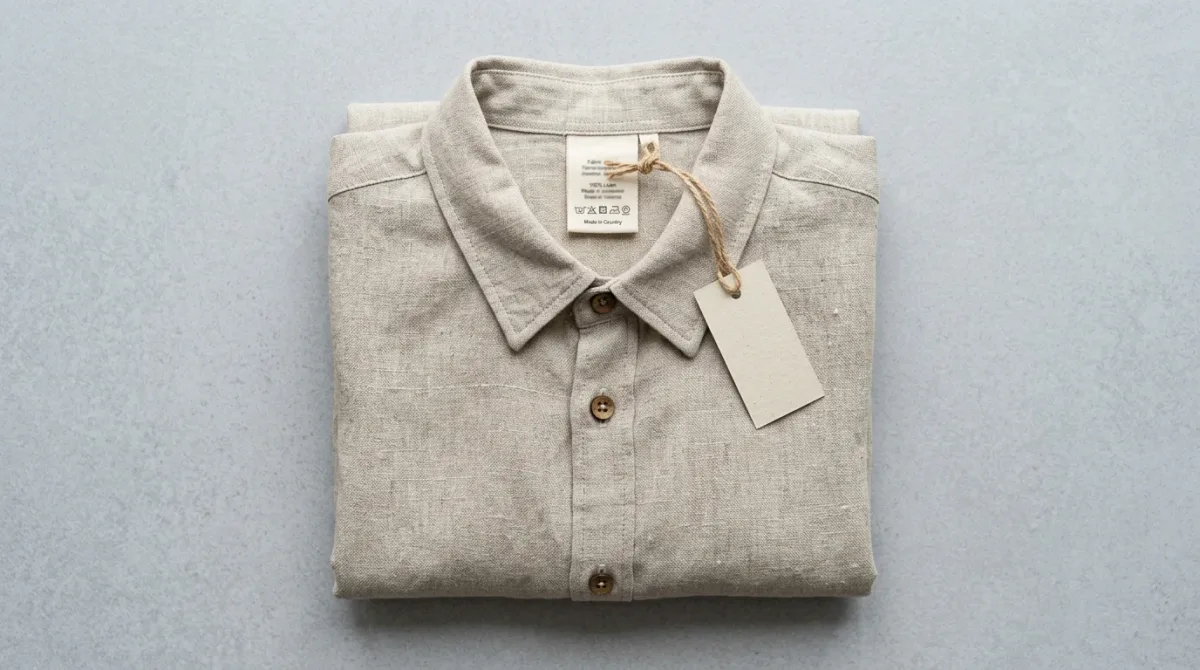
A clothing label is closer to a legal document than a marketing surface, and the rules behind it are public. In the United States, a sweater may only be called cashmere if the fiber averages no more than 19 microns in diameter. Learn what each required line has to mean, and a rack of near-identical garments stops looking identical.
What is a clothing label required to tell you?
Three things, and only three. Guidance from the Federal Trade Commission on the Textile and Wool Acts requires a covered garment to disclose its fiber content by generic name and percentage by weight, its country of origin, and the identity of the manufacturer, importer or dealer — a company name or an RN number. Everything else on the tag is copy.
The order is data, not decoration. The FTC guidance requires fiber names and percentages to run in descending order of predominance, so the first fiber named is the one there is most of by weight. A tag reading 60% polyester, 40% wool is describing a polyester garment with wool in it, whatever the hangtag photography suggests.
Why does the five percent rule change how you read a blend?
Because a fiber can be in the garment and absent from the label. The FTC guidance requires fibers making up five percent or more of the weight to be named; anything under that threshold may be disclosed only as "other fiber" or "other fibers," with several minor fibers aggregated into one line.
Two exceptions are worth carrying into a fitting room. Wool and recycled wool must be named and given a percentage regardless of how small the quantity is — so wool never hides inside "other fibers." And a fiber below five percent may be named when it has what the FTC calls definite functional significance, with spandex added for elasticity given as the example.
That flips the usual reading. A shirt marked 97% cotton, 3% other fiber comes from a maker who could have named a functional fiber and did not; 96% cotton, 4% elastane comes from one who decided the stretch was worth declaring.
Trim is the other blind spot. Under the FTC guidance, collars, cuffs, braiding, elastic materials and decorative trim from embroidery or appliqué are exempt from disclosure when the decoration covers no more than 15 percent of the surface area, and ornamentation under five percent of fiber weight is handled with the phrase "exclusive of ornamentation." The label describes the body of the garment, not always the parts you are buying it for.
Does the word cashmere guarantee anything?
More than almost any other word on a tag. The FTC guidance permits the term only when the fiber is the fine undercoat of the cashmere goat, its average diameter does not exceed 19 microns, and no more than three percent by weight of the fibers exceed 30 microns in average diameter. Fiber that misses those marks must be labeled wool.
Read what that does and does not cover. It is a specification about fiber fineness, not about yarn ply, knit density, spinning or finishing — the variables that decide whether a sweater pills into fuzz by February. Two garments can both be honestly labeled 100% cashmere and behave nothing alike.
"Recycled wool" is similarly precise and similarly easy to misread. The FTC defines it as wool returned to a fibrous state after having been woven, knitted or felted into a wool product, regardless of whether a consumer ever used that product. Mill offcuts qualify. The term is a process description, not a claim about a second life.
What does the care label actually promise?
A tested procedure, permanently attached. The Care Labeling Rule at 16 CFR Part 423 defines a care label as a permanent label attached so that it will not become separated from the product and will remain legible during the useful life of the product. A care tag that is already curling in the store is a manufacturing tell.
The rule also requires a reasonable basis for the instruction — evidence such as testing showing the product is not harmed when cleaned as directed, evidence of harm for methods warned against, or technical literature and industry expertise. And warnings are mandatory when part of a prescribed procedure would harm the product or others washed with it, phrased with clear language such as "Do not," "No" or "Only."
Two definitions from the rule are worth memorizing. "Machine wash" assumes hot water up to 145 degrees Fahrenheit unless a temperature is stated, which is why an unqualified machine-wash instruction on a fine knit deserves suspicion. And the rule distinguishes a generic "Dryclean" from "Professionally dryclean," the latter signalling that a cleaner needs to modify the standard process.
The silence matters too. The rule does not require warnings about alternative procedures the label never mentions, so the absence of "do not tumble dry" is not permission to tumble dry.
What can no label tell you?
Construction, which is where most of the money either went or didn't. The University of Georgia Extension's textiles guidance puts it directly: the real story is told on the label and inside the garment, and it lists puckered and raveling seams and ragged buttonholes among the flaws worth catching before the register.
Its checks are quick enough to run in a fitting room. Are the seam allowances generous and the raw edges finished against fraying? Are the seams flat and the darts tapered? Do the underarm seams of sleeve and bodice meet precisely, and do plaids or stripes match across a seam? On zippers and buttonholes, the guidance notes that metallic-coloured teeth generally indicate better quality than painted ones, and that buttonholes should be closely stitched without loose threads. Hems should be deep enough to let out.
Reporting from NPR's Life Kit in May 2026 adds a sequence for doing this fast. Fashion educator Andrea Cheong, speaking to NPR, recommends checking for snags, peeling or bubbling picked up during other people's try-ons, turning the garment inside out to see whether the interior finishing matches the exterior, and giving seams a light tug to confirm they hold without gapping. She also advises matching material to purpose — wool for warmth, linen for cooling.
Cheong draws one distinction that saves good clothes from being dismissed: fragility is not a defect. Of pieces such as silk or beaded garments that require hand-washing, she told NPR, "That doesn't mean it's bad quality."
What does each line guarantee, and what does it leave out?
A compact version of everything above, for the moments when a label is in one hand and a queue is forming behind you.
| Line on the label | What the rule guarantees | What it does not cover |
|---|---|---|
| Fiber percentages | Generic names, by weight, in descending order | Yarn quality, spinning, knit density |
| "Other fibers" | Each unnamed fiber is under five percent by weight | Which fibers they are, or what they do |
| "Cashmere" | Undercoat averaging 19 microns or finer, with a three percent tolerance above 30 microns | Pilling, ply, hand, longevity |
| "Recycled wool" | Wool returned to a fibrous state after being woven, knitted or felted | Whether a consumer ever wore it |
| Care instruction | A reasonable basis for the method named, permanently attached | Methods the label never mentions |
| Country of origin, RN number | Who is accountable for the claims | Where the fiber or fabric was made |
None of this makes a label a verdict. It makes it a floor: a set of statements someone can be held to, sitting underneath a garment you still have to judge with your hands. Read the tag for what it is legally required to mean, check the seams for everything it is allowed to leave out, and the difference between a good buy and an expensive one stops being a matter of instinct.
For a related style perspective, read How to read a clothing label before you buy — Style.
For more context, read How to read a fabric label before you buy.