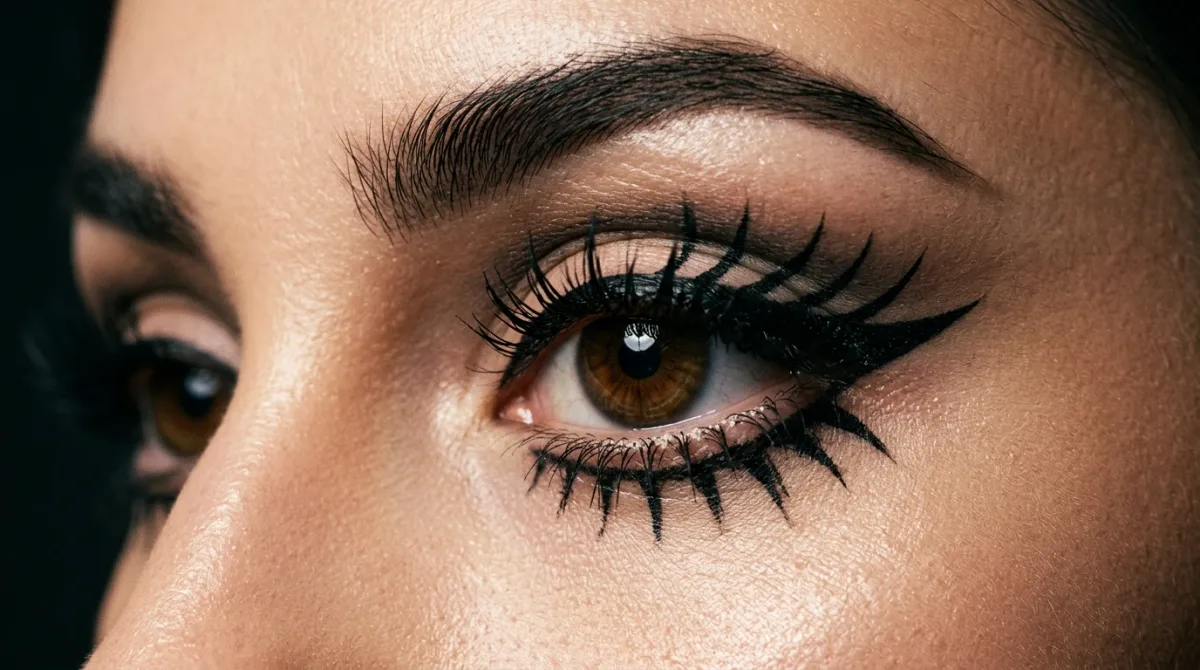
In February 1966, sixteen-year-old Leslie Hornby—soon known as Twiggy—became London's “Face of 1966” after a photograph of her hand-painted lower lashes ran in the Daily Express, a look she later said began not as professional make-up but as a copy of a childhood rag doll.
The story survives because Twiggy told it herself, in her own words, to CBS News decades after the fact: “I copied that. I had a rag doll in my bedroom, and she had those painted eyes. Like a Raggedy Ann.” It is a small confession, but it reframes what is usually filed under nostalgia—the doe-eyed, spider-lashed face of the Swinging Sixties—as something closer to design theory: a teenager reverse-engineering a toy's fixed, painted stare and putting it, deliberately, on a living face.
How did a rag doll end up on Twiggy's eyelids?
According to CBS News, Hornby was discovered at sixteen after a visit to the House of Leonard salon in London, where a promotional photograph of her new haircut caught the eye of a Daily Express fashion editor on February 23, 1966. Within days she was reproduced across the paper as the “Face of 1966,” and the eye look that came with the haircut—heavy upper lashes multiplied with false ones, and lower lashes drawn on by hand—became inseparable from the name.
The Fashion, Interior Design and Merchandising Museum at Arizona State University, in an archival profile of Hornby, describes the same lower-lash detail as painted rather than applied: “the doll-like black eyelashes she painted under her eyes,” a mark the museum notes reinforced “an impression of childlike androgyny” and later reappeared, unmistakably, on the packaging of her own licensed make-up line, sold to fans as a Twiggy-branded kit in 1967 and 1968. No stylist or make-up artist is credited with originating the look in either source; by both accounts, it was Hornby's own hand at the mirror, not a session with a professional.
Why does the doll reference matter more than the trend?
A face this widely copied usually gets absorbed into “the Sixties look,” a shorthand that treats the era's beauty as one undifferentiated mood board. The doll detail resists that flattening. A rag doll's eyes are not drawn to flatter a face; they are drawn to read instantly, at a fixed size, from across a room—a convention closer to graphic design than to cosmetics. Twiggy's account describes lifting that convention wholesale: not softened, not adapted to her own bone structure, but copied, mark for mark, from a toy.
That is what separates a signature look from a passing trend: it can be described as a rule rather than a feeling. Upper lash multiplied for density, lower lash drawn rather than lined, both aimed at manufacturing the fixed, wide-eyed stare of an object rather than the soft-focus glamour her predecessors had traded in. The rule was legible enough that photographers, magazines and eventually a licensed cosmetics line could all reproduce it without her in the room.
How does the look sit inside London's wider style revolution?
Twiggy's eye did not arrive in isolation. The same Chelsea scene that produced her had already been reorganized, a few years earlier, around Mary Quant, who opened her Bazaar boutique on King's Road in 1955 and had built, by the time Hornby was photographed, what the Victoria and Albert Museum calls the defining fashion identity of the decade. The V&A, whose Mary Quant retrospective ran from 6 April 2019 to 16 February 2020, credits Quant with popularizing the miniskirt, launching a mass-market Daisy cosmetics line alongside her clothing, and reaching, by decade's end, an estimated seven million customers—evidence, as the museum frames it, of a London fashion economy built on mass reproducibility rather than one-off couture.
Twiggy's face belongs to that same logic, translated into make-up. Where Quant's clothes could be copied in a factory, Twiggy's eyes could be copied at a bathroom mirror, using nothing more specialized than a kohl pencil and a set of false lashes—the same democratizing instinct, applied to a face instead of a hemline. The rag-doll origin story is not incidental to that reading; it is the clearest evidence for it. A look invented by imitating a toy, using no professional technique at all, was always going to be one anyone could imitate back.
Did the look outlast the moment, or just the photograph?
By most measures it outlasted the photograph. CBS News's account of Hornby's later career—two Golden Globes for the 1971 film The Boy Friend, a Tony-nominated Broadway run opposite Tommy Tune in My One and Only, five seasons judging America's Next Top Model, and her own perfume and make-up lines—describes a working performer who kept returning to the same face rather than shedding it for a new one each decade. That is unusual. Most breakout looks of a given year are retired by their own muse within a few seasons, overtaken by whatever a magazine decides is next.
What kept Twiggy's eye current was precisely its portability. Because the technique could be stated as a set of instructions—lashes multiplied above, a line painted below, both aimed at width rather than depth—it did not depend on a particular face, a particular decade's palette, or a particular photographer's lighting to register. A doll's eyes are legible on a page, on a box, on a licensed lash strip, or on a teenager copying a magazine at her own bathroom mirror, which is exactly the range of surfaces Twiggy's version ended up traveling across between 1966 and 1968.
What does the doll-eye case still argue about a beauty look?
The durability of Twiggy's eye is not evidence that it was original in some absolute sense—doll-like eyes existed long before 1966—but that it was legible: reducible to a rule, traceable to a stated source, and reproducible without its inventor present. That is a narrower and more useful definition of an iconic beauty look than “it captured a moment.” It is closer to a design brief that happened to write itself, on a sixteen-year-old, from a toy in a London bedroom.
For a related art perspective, read The Grid and the Body: How Yves Saint Laurent Turned a Mondrian Painting Into a Dress.