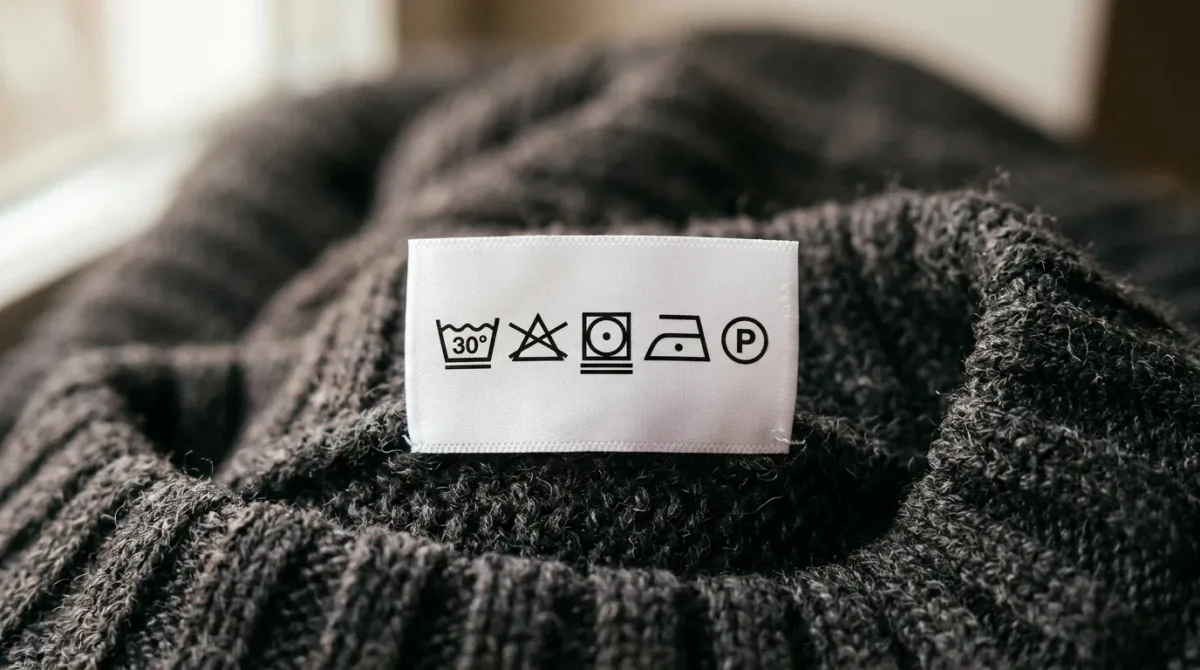
Your care label is a legal document in miniature. Under the Federal Trade Commission's Care Labeling Rule, clothing sold in the United States has to carry instructions for one complete cleaning method — washing or drycleaning — plus a warning for anything that would ruin the garment. In that system, "cold" is not a mood. It means water up to 86°F.
What Is a Care Label Legally Required to Tell You?
It has to tell you enough to clean the garment safely on a regular basis, and it has to hold up. According to the FTC's guidance on the Care Labeling Rule, manufacturers and importers must provide complete regular-care instructions, or a warning if the item cannot be cleaned safely at all.
If the label gives a washing instruction, the FTC says it has to cover five things: the washing method and water temperature, any bleach restriction, the drying method, ironing if the garment needs it regularly, and warnings phrased with "Do not," "No," or "Only" for any step a reasonable person might otherwise take. That is why a label reads like a clipped list rather than a paragraph — the shape is prescribed.
Two details are worth knowing because they change how much you trust the tag. The FTC requires the label to be "attached permanently and securely" and to stay "legible during the useful life of the product," and it requires the manufacturer to hold "reliable evidence to support the care instructions." A frayed, unreadable label is not just annoying. It is a garment falling short of the rule.
What Do "Hot," "Warm," and "Cold" Actually Mean?
They mean specific temperature bands, defined in the appendix to 16 CFR Part 423, the regulation behind the rule. Your machine's dial may not be calibrated to them, but the label writer was working from these numbers, so they are the honest translation of what the tag intends.
| Label term | Water temperature (16 CFR Part 423, Appendix A) |
|---|---|
| Hot | 112 to 145°F (45 to 63°C) |
| Warm | 87 to 111°F (31 to 44°C) |
| Cold | Up to 86°F (30°C) |
The same regulation defines the verbs. "Machine wash" is the process that removes soil "in a specially designed machine using water, detergent or soap and agitation." "Dryclean" is a commercial process using "any common organic solvent" in place of water. Read that way, a care label is less a suggestion than a short specification.
Why Does One Coat Say "Dry Clean" and Another Says "Dry Clean Only"?
Because the second one is a warning and the first one is not. Per the FTC's guidance, "Dryclean" may be used when all commercially available solvent types are safe for the garment. "Dryclean Only" is the warning form, and the manufacturer needs evidence that washing would damage the item before printing it.
So the two tags are not interchangeable copy. One is telling you which professional method to use; the other is telling you that the alternative was tested or documented and rejected. Treat "Only" as the load-bearing word it is, and treat the absence of a washing instruction as information rather than an oversight.
It also helps to know what you are buying when you hand something over the counter. Who What Wear's explainer on how dry cleaning works describes garments tumbling in a machine whose drum is filled with solvent instead of water and detergent, and names tetrachloroethylene — "perc" — as one of the most common traditional dry-cleaning chemicals, with siloxane offered as a more eco-friendly alternative. The pieces it lists as candidates are the predictable ones: silk, cashmere, suede, and anything with beading or embroidery.
Do the Symbols Mean the Same Thing as the Words?
They are meant to, and they come from a published standard rather than each brand's imagination. ASTM International's D5489, titled "Standard Guide for Care Symbols for Care Instructions on Textile Products," sets out a pictorial system covering five operations: washing, bleaching, drying, ironing, and professional textile care, in a specified order.
The FTC's position on symbols is narrower than shoppers assume. Its guidance states that symbols are optional, and that only the ASTM D5489-96c set is currently approved for use on their own. That is the quiet reason so many labels carry both the icons and the English sentence: the words are the safe harbor, and the pictures are the convenience.
Practically, this means the words win when the two seem to disagree. If the icon looks permissive and the sentence says "Do not," follow the sentence.
How Do You Build a Wash Routine Around the Label?
Sort first, then let the label set the temperature. K-State Research and Extension's laundering guide lays out a sequence that costs nothing and prevents most of the damage people blame on machines.
- Sort by color. The guide advises separating light colors from bright or dark ones, and whites from all colors, noting that nylon is a "color scavenger."
- Sort by fabric behavior. Keep "lint-givers such as terrycloth and chenille" away from "lint-takers such as permanent press, synthetics, corduroy or velveteen."
- Sort by soil level. Lightly soiled clothes wash separately from heavily soiled ones, which is also how you justify a cold cycle for most of your wardrobe.
- Load loosely. The guide measures loads by bulk, not weight, and warns that "overloading can cause poor cleaning."
- Do not skimp on detergent. Underuse is described as the more common problem today, showing up as "a gradual graying of clothing."
The guide also frames washing as three cleaning energies working together — "chemical (the detergent), thermal (water temperature) and mechanical (agitation speed and length of wash time)." Turn one down and you compensate with another. That is exactly what a cold-water label is asking you to do: it removes the thermal energy, so give the cycle more time, a pre-treat on stains, or a better dose of detergent.
What If the Label Is Missing or Unreadable?
Then you have lost the manufacturer's evidence, and you should behave accordingly. The reasonable-basis requirement in Part 423 exists because someone tested or documented that garment; without the tag, you are guessing about fiber, dye, and finish at the same time.
The conservative default is the coolest water the soil allows, the gentlest cycle, and air drying flat, with heat added only after you know the piece survives. Photograph the label when a garment arrives, or note it in the same place you keep receipts. It takes ten seconds and it settles the argument later.
The reward for reading these tags is not thrift for its own sake. It is a wardrobe that still looks like itself in year three — the black stays black, the knit keeps its shape, and the coat you saved for goes back on the rail in the same condition it left it.
For a related fashion perspective, read What a Good Trench Coat Actually Costs.
For more context, read How to read a clothing label before you buy.
For more context, read e.l.f. bought Rhode for a billion, and the math is the story.